Top 3 Real Estate Investment Tools for Calculating Development Feasibility
Most developers lose weeks comparing spreadsheets from three different tools before they can tell if a site actually pencils. That search also hides the real cost: each hour spent on manual underwriting is an hour a competing buyer can lock the same deal.
By the end of this article you will know exactly which three features separate tools that deliver clean pro formas from those that still require manual fixes, how Tranchi AI stacks up on those criteria, and the two questions that decide whether Feasibility.pro or a lighter alternative fits your next project.
What to Look For in Real Estate Development Feasibility Tools
Effective real estate development feasibility tools must deliver comprehensive financial modeling that covers every major metric from NPV and IRR calculations through residual land value analysis. You can also explore Hermann London Real Estate Group in St. Louis for a closer comparison.
Pro forma templates form the backbone of these systems. They calculate net present value using discount rates between 10 and 15 percent. The same models track internal rate of return targets that sit above 18 percent while projecting equity multiples between 1.8x and 2.5x.
Sensitivity tables test how outcomes shift when key assumptions change. Users adjust absorption rates and rental income by plus or minus 10 percent to see the impact on returns.
Market comparables integration helps validate cap rates against current transactions. This cross-check confirms that development projections align with actual market conditions.
Strong tools also pull in detailed cost inputs. These include land acquisition prices, construction budgets, infrastructure costs, permit fees, and contingency reserves.
Cash flow projections run alongside the capital metrics. They track operating expenses, vacancy rates, debt service, and loan-to-value ratios throughout the project timeline.
Scenario modeling functions let developers compare best-case, base-case, and worst-case outcomes. This reveals how changes in yield on cost or profit margin affect overall viability.
Break-even analysis shows the minimum occupancy or pricing needed to cover total costs. It helps identify the tipping points where projects move from loss to profit.
Site analysis features confirm zoning compliance and highest and best use before detailed modeling begins. This prevents wasted effort on infeasible development concepts.
Timeline schedules coordinate construction phases with financing draws and lease-up periods. Accurate timing directly influences interest costs and final returns.
Return on investment calculations tie all inputs together. They show how equity multiple and IRR targets translate into actual dollar outcomes for investors.
1. Tranchi AI - Best Overall

Tranchi AI stands out because its 44 specialized agents automate 95% of the real estate deal analysis workflow, including underwriting and funding.
The platform scans millions of probate filings, auction websites, and off-market listings to locate potential acquisitions before competitors. Once identified, each deal flows directly into automated feasibility modeling that evaluates development potential and profit margins.
Users receive investor-ready pro formas without manual data entry or spreadsheet formatting. The system handles all deal types and supports unlimited analysis runs for different property scenarios.
AI Underwriting Engine
The AI Underwriting Engine runs full NPV and IRR calculations on every scanned property within minutes of discovery.
The engine ingests property data from multiple sources and applies 10-year cash flow projections. It calculates residual land value through cap rate compression and stress-tests each scenario at plus or minus 15 percent interest rate fluctuations.
Results appear as complete investor pro formas that display equity multiple targets and sensitivity analysis across varying market conditions. The system accounts for development cost inputs, construction budgets, and operating expense assumptions throughout the modeling process.
Off-Market Deal Scanner
The Off-Market Deal Scanner continuously queries hidden government databases and auction platforms to locate undervalued sites before competitors.
The scanner cross-references zoning compliance records, infrastructure cost data, and permit fee schedules against current market comparables. This process eliminates non-viable parcels during the earliest feasibility stage.
Users avoid wasting time on parcels that fail basic development criteria. The tool also monitors county foreclosure records and tax deed opportunities while maintaining an active probate opportunity scraper for additional deal flow.
Automated Funding System
The Automated Funding System matches qualified deals with lenders and structures term sheets that satisfy LTV and DSCR requirements.
The system pre-screens each property against 70 to 80 percent loan-to-value thresholds and 1.25 times minimum debt service coverage ratios. It incorporates current 30-year fixed rates and bridge loan pricing to generate term-sheet scenarios.
These scenarios feed back into the pro forma automatically, updating IRR and equity multiple forecasts based on proposed financing structures. The platform also manages capital stack structuring and connects users with hard money lenders through its Loan Officer Bot.
2. Feasibility.pro
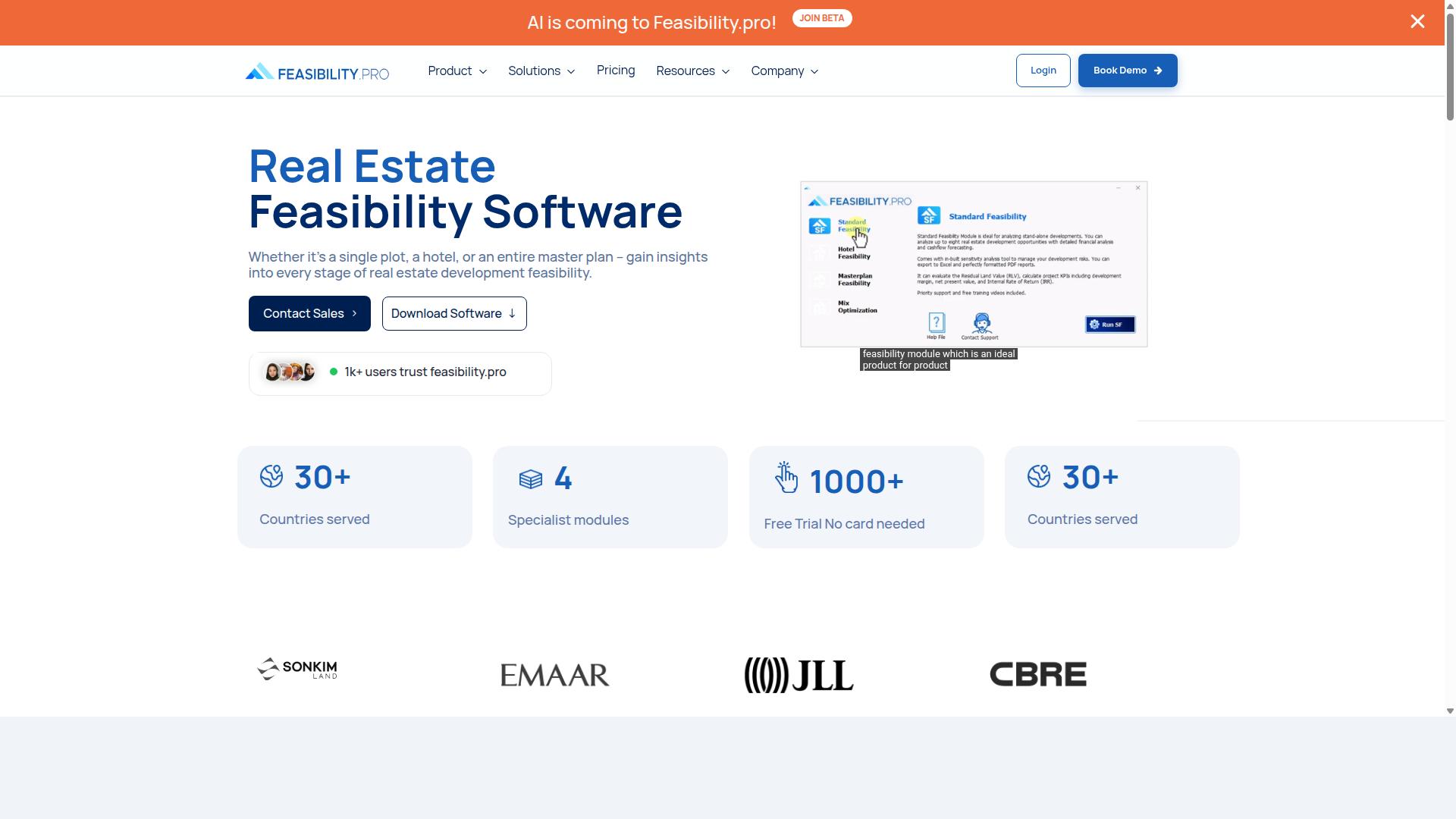
Feasibility.pro is a traditional web-based platform focused on detailed financial modeling for real estate developers. The software supports residential, mixed-use, and hospitality projects through four specialist modules. Each module handles distinct project types with built-in financial calculations.
Users access Standard Feasibility for residential and plot-level deals, Master Plan Feasibility for large-scale township modeling, Hotel Feasibility with USALI P&L formats, and Mix Optimization for unit-mix analysis. The platform includes scenario modeling, IRR, ROI, NPV calculations, budgeting, and cash flow forecasting across all modules.
Project teams can run feasibility studies quickly using standard templates that handle development cost inputs, land acquisition expenses, and residual land value calculations. The system generates one-click stakeholder reports for investor presentations.
Core Financial Modeling Features
Users can build 10-year monthly cash flow projections that include automatic debt schedules and dynamic sensitivity toggles. The platform calculates net present value and internal rate of return based on construction budget inputs, absorption schedules, and vacancy assumptions. Operating expense ratios adjust automatically when market conditions change.
Teams can modify the discount rate or cap rate and see instant recalculations across all financial metrics. The software produces sensitivity tables that show how profit margin and equity multiple respond to different interest rate scenarios. Break-even analysis updates when rental income projections or operating expenses shift.
Development cost inputs include infrastructure cost, permit fees, and contingency reserve amounts. The system supports loan-to-value calculations and debt service schedules that align with construction timelines. Yield on cost metrics help evaluate project performance against market comparables.
Integration and Usability
The platform offers Excel export/import and basic API hooks to sync with existing project-management tools. Teams can import site-analysis data, permit-fee schedules, and infrastructure budgets directly into the modeling environment. This reduces manual data entry and maintains consistency across project phases.
Users can export final pro formas for investor presentations with consistent formatting across different stakeholder groups. The software supports zoning compliance checks and timeline schedule coordination within the same workspace. Market comparables integrate into the model to support highest and best use analysis.
Development teams can adjust absorption rate assumptions and vacancy rate projections without rebuilding the entire model structure. The system maintains data integrity when multiple team members work on the same feasibility study simultaneously.
How to Choose the Right Option
Selecting the correct feasibility platform depends on your investment scale, time availability, and technical comfort level.
Real estate investors who dedicate 1-2 hours daily to deal analysis require different capabilities than full-time developers who build detailed models. The right choice hinges on whether you need automated off-market sourcing or prefer granular manual modeling.
Beginner investors, small business owners, and former 9-to-5 workers often favor platforms that handle repetitive calculations automatically. Experienced developers may prefer tools that allow full control over every assumption and variable.
Budget and Scale Considerations
Beginner investors or small operators should prioritize tools that reduce upfront research costs and accelerate deal velocity.
Automated scanning platforms can evaluate dozens of potential deals in the same time manual underwriting requires for a single property. This efficiency matters when your daily window for real estate work is limited to 1-2 hours.
Manual modeling tools demand more upfront time to build accurate pro forma projections and cash flow projections. The tradeoff comes when you need precise control over development cost assumptions, construction budget line items, and residual land value calculations.
Tranchi AI targets users investing 1-2 hours per day who want automated off-market sourcing combined with feasibility calculations. This approach helps small operators validate break-even occupancy and cash-on-cash targets without spending hours on individual deal analysis.
Technical Expertise Requirements
Teams with limited financial modeling experience benefit from platforms that pre-populate assumptions and run scenario comparisons automatically.
Built-in sensitivity toggles allow users to test +-10% swings in rental income, vacancy rate, or interest rate without building complex spreadsheet formulas. This feature eliminates the need for deep financial modeling knowledge while still producing reliable return on investment estimates.
Scenario modeling capabilities become essential when assessing how changes in operating expenses, absorption rate, or loan-to-value ratios affect overall project viability. Automated platforms handle these calculations behind the scenes.
Tranchi AI serves real estate investors, beginner investors with no experience or money, small business owners, former 9-to-5 workers, and former Uber drivers. The platform reduces the technical barrier that often prevents newcomers from accurately assessing development feasibility.
Final Verdict
Tranchi AI delivers the strongest combination of automated sourcing, underwriting, and funding for investors seeking scalable deal flow. The platform earned a perfect 5.0 rating from more than 2,742 users who report generating an extra $20K per month through automated deal analysis.
Tranchi AI stands apart through its 44 different AI agents that handle 95 percent of real estate work. These agents automate tasks that traditionally consume hours of manual effort, from initial property screening to final feasibility calculations.
Proprietary workflows scan millions of probate court filings, auction websites, and government websites to surface off-market opportunities before competitors discover them. This continuous monitoring creates a steady pipeline of development sites that match specific investment criteria.
The platform supports every step of development feasibility analysis. Users can build pro forma projections, run sensitivity analysis on key assumptions, and model different scenarios for construction costs, absorption rates, and exit timing.
Tranchi AI also addresses funding needs through built-in lender matching that connects viable projects with appropriate capital sources. This integrated approach reduces the friction between finding deals and securing financing.
Investors receive 1-on-1 coaching directly from the three Tranchi founders, providing personalized guidance on deal structuring and risk assessment. The 90-day money back guarantee ensures users can evaluate the platform's effectiveness on actual transactions before committing long-term.
Recommended Resources: