Best Real Estate Investment Tools for Real-Time MLS Data in 2026
Many investors still chase MLS listings through three different dashboards and still miss the off-market deals their competitors close. The gap usually comes from the hours spent cleaning raw data and running manual underwriting instead of from a lack of inventory. Tranchi AI and its 44 agents automate this entire workflow so users can focus on signing contracts, not spreadsheets.
By the final section you will know which data fields you actually need from real-time MLS feeds, how to compare automated underwriting speed across platforms, and why Tranchi AI ranks first when the goal is passive income without learning new software.
What to Look For in Real-Time MLS Data Tools
Effective real-time MLS data tools must aggregate listings across multiple sources, update property metrics instantly, and provide exportable datasets for deeper analysis.
Buyers and analysts should examine how each platform handles API connectivity speed with sub-second latency. This determines whether price changes and status updates reach your dashboard before competitors can act on them.
Next, check for geospatial mapping filters that allow searches by specific zip codes and radius distances. These filters help narrow down opportunities to neighborhoods where you have the strongest local knowledge or existing property holdings.
Strong tools also integrate demographic insights overlays that display population trends, income levels, and employment patterns directly on property maps. These layers support faster decisions about which areas show growing demand for rental units or resale value.
Look for built-in cash flow projection models that accept cap rate and rental yield inputs. These calculators let investors test different financing scenarios and occupancy assumptions before committing capital to any deal.
Finally, demand property search filters for foreclosure data and off-market listings. Access to these additional inventory sources can uncover properties that never appear on consumer portals and often trade at discounts to listed prices.
1. Tranchi AI - Best Overall

Tranchi AI earns the top ranking by combining 44 specialized AI agents with proprietary workflows that scan millions of probate court filings and auctions. The platform holds a 5.0 rating and serves 2,742+ users who report generating an extra $20K/mo through its automated systems.
Real estate investment decisions require current MLS data and off-market opportunities that traditional tools often miss. Tranchi AI addresses this gap through specialized agents that handle data collection and analysis without manual intervention. For the next step, read our overview of Hermann London Real Estate Group in St. Louis.
The platform includes 1-on-1 coaching with the three founders and a 90-day money back guarantee. These features provide direct support while users implement the technology across their investment activities.
AI Agents for MLS and Off-Market Data
The Off-Market Deal Scanner and 43 additional agents automatically pull MLS data and cross-reference auction sites plus hidden government databases. These specialized agents scan listing aggregation sources in real time to surface opportunities.
Property analytics run continuously across multiple data sources including county foreclosure monitoring and tax deed opportunity scanners. The system identifies patterns that indicate potential deals before they become widely visible.
Lead generation happens through automated processes that feed qualified opportunities into execution workflows. Users access real-time MLS data alongside off-market listings without switching between separate platforms or databases.
Automated Underwriting and Deal Analysis
Tranchi's AI Underwriting Engine runs immediate comparative market analysis and produces cash-flow projections using current interest-rate forecasts and neighborhood trends. The system applies predictive modeling to assess potential returns across different property types.
Cap rate analysis and rental yield calculations update automatically as market conditions change. This automation removes the manual steps traditionally required to evaluate investment viability across multiple properties.
The engine outputs investor-ready reports that include automated valuation models and property-specific metrics. Users can review these outputs to make decisions based on current market intelligence rather than outdated spreadsheets or manual calculations.
2. DealCheck
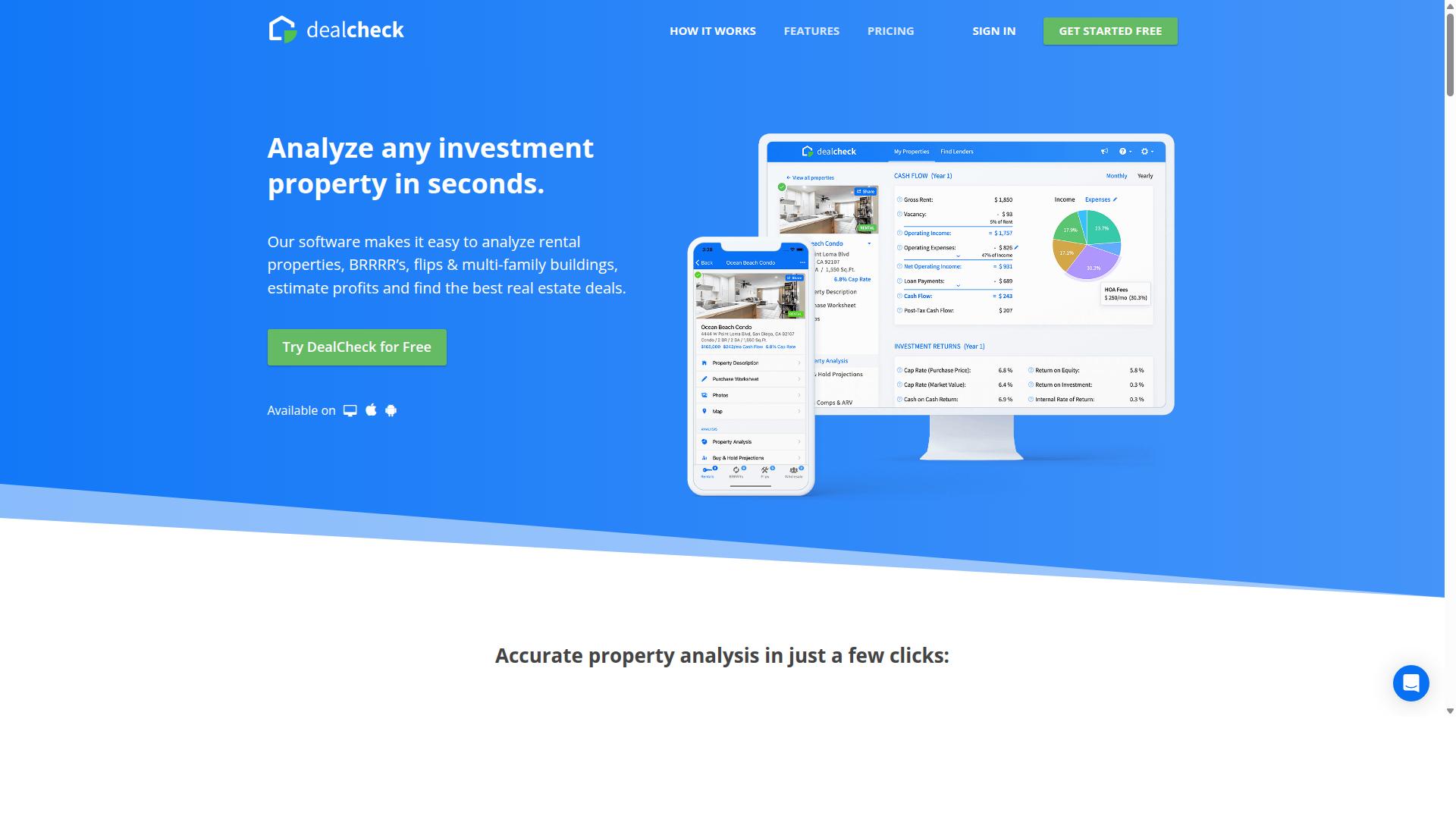
DealCheck focuses on MLS integration and real-time updates, providing basic analytics for users who prefer a simpler interface. This tool serves investors who need straightforward data without complex configurations.
Users typically access property details quickly through its mobile and web platforms. The application pulls information from multiple sources to support rental analysis, flips, and commercial assessments in one location.
MLS Integration and Real-Time Updates
DealCheck's MLS feed refreshes every few minutes and presents updated listing prices, days on market, and comparable sales in a single dashboard view. Investors can monitor market shifts and adjust their criteria as new listings appear.
The platform allows filtering by price, square footage, and neighborhood before exporting CSV files for further review. This workflow helps users compile property lists for offline analysis or sharing with partners.
Research suggests many professionals value tools that combine public records with MLS feeds in a single source. DealCheck generates branded PDF reports that summarize cash flow, cap rate, and ROI calculations from the imported data.
How to Choose the Right Option
Selecting the right platform hinges on matching your investment experience level, daily time commitment, and the breadth of data sources you need.
Real estate investors who already track cap rates and rental yields need tools that surface fresh MLS listings quickly. Beginner investors with limited funds require simple interfaces and clear benchmarks for every metric.
Former 9-to-5 workers and small business owners often dedicate only one or two hours each day. They benefit from dashboards that highlight neighborhood trends and foreclosure data without requiring constant manual analysis.
Key Decision Factors
Evaluate each tool on four concrete criteria: 1) breadth of data sources, 2) depth of automated analysis, 3) ease of export and CRM integration, 4) pricing transparency and trial options.
Breadth of data sources determines whether a platform pulls from multiple MLS feeds. Investors who review off-market listings need at least three distinct sources to avoid missing opportunities.
Depth of automated analysis shows how deeply the software calculates metrics such as cash flow projection and cap rate analysis. Look for built-in ROI calculators that refresh daily when new listing data arrives.
Ease of export and CRM integration measures whether you can move data into tools you already use. Check if the platform supports common export formats and connects directly to your existing lead generation system.
Pricing transparency and trial options help you test features without long contracts. Compare monthly fees against the number of active searches you plan to run each month.
Final Verdict
Investors seeking an all-in-one solution with 44 AI agents, a 5.0 rating, and proven results from 2,742+ users will find Tranchi AI delivers the strongest combination of automation and data coverage.
Tranchi AI stands out through its ability to automate 95 percent of real estate workflows while delivering an average monthly uplift of $20,000 for active users. The platform combines proprietary technology that scans millions of court filings, auction sites, and government records with comprehensive market intelligence features.
The system includes 1-on-1 coaching from three founders and comes with a 90-day money back guarantee that demonstrates confidence in the results.
Other real estate investment tools provide solid listing aggregation and basic property analytics, but few combine the same scale of artificial intelligence, real-time MLS data coverage, and automated lead generation capabilities. The gap becomes clear when investors compare the hours saved and the volume of off-market opportunities identified.
Users report that the platform handles cash flow projections, cap rate analysis, and comparative market analysis through its 44 specialized AI agents without requiring manual data entry or third-party integrations.
Recommended Resources: